
NUVETHREN✳Follow the making ↗

An original world by Boon

A world beyond
enough.

Everything can be provided.
A reason to stay cannot.

In a city where machines meet everyday needs, a repairer and his daughter discover how much is still ours to choose.

Enter Table House ↓
NOVEL / MANGA / TRADING CARD GAME
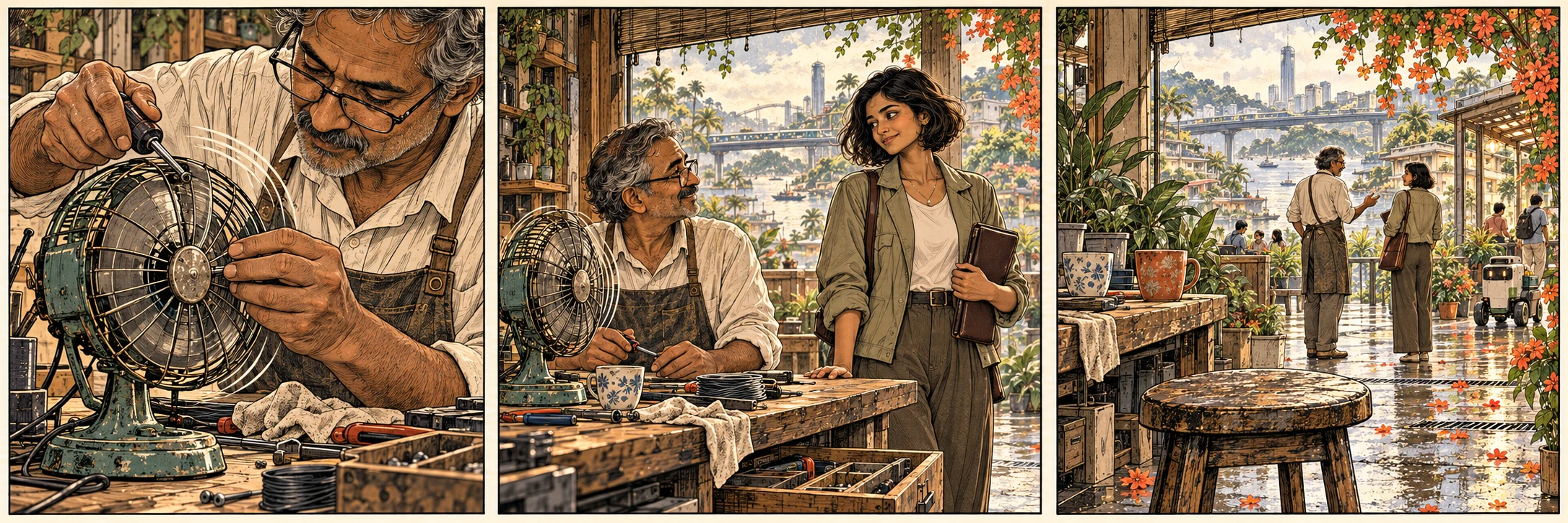
Arun at a worn repair bench with an old fan, Mara arriving through the garden entrance, an empty stool between them and a delivery robot outside.01 / TABLE HOUSE · AFTER THE RAIN

Look closer

Every object
has a story.

A skill that still matters

It works. That was never the question.

A replacement could have arrived in minutes. Arun spent three mornings finding the click. Repairing the fan gives him something useful to do. Whether its owner still needs it is another matter.

1 of 3 details explored

02 / A moment, in panels

The Fan.

One ordinary morning. A repaired fan. A daughter at the door. The start of a much harder conversation.

Three panels, read left to right: Arun repairs the fan; Mara arrives at his bench; an empty stool remains as they talk near the garden.

Read left to right. Select a panel to look closer.

The opening, in prose

“The fan stopped clicking just as the courier reached the door.”

AI-assisted illustration and adaptation study. Character designs are exploratory; this is not a completed manga chapter.

03 / A seat at the table

What would
you preserve?

The city offers Arun a better workshop. His old hall could become an accessible care commons. Both can be well equipped. The old Thursday gathering cannot be supplied on request.

A thought experiment

Keep the familiar place,
or open it to a new future?

Choose the instinct you feel first. Then hear what it leaves unresolved.

More than one reasonable answer

Nobody is choosing
between good and evil.

Arun wants continuity. Others want a place that welcomes different lives. Better tools can solve practical problems; they cannot decide what everyone should value.

Make a choice to hear two perspectives.

Your choice stays in this browser. This is not a public poll, and it does not decide the novel’s ending.

04 / People before positions

Family.
Then everything else.

A father and daughter can disagree about a public decision without their votes becoming a test of love.

01Arun Das61 / The repairer+

He knows how almost everything at Table House fits together. What he does not know is who he will be if people stop needing him to fix it. He wants the Thursday table to keep filling up.

02Mara Sen27 / The archivist+

Arun’s daughter helped certify the district’s decision records. Now she must ask whether a response made under an old permission really expresses what someone wants today—and what correcting her own work will cost.

03Ren Sen49 / The organiser+

Mara’s mother misses the clarity of being in charge. A local campaign gives her a cause and a difficult new question: can she contribute without controlling the result?

04Devika Rao78 / The engineer+

She remembers the invisible work that automation relieved. Giving people more say should not mean handing all that unpaid labour back. She refuses a simple story in which the machines are the problem.

05Tavi & Isha22 & 11 / Different kinds of freedom+

Tavi wants recognition at the card table in a world full of powerful tools. Isha wants quiet time to draw with a friend. Neither exists to teach the adults a convenient lesson.

05 / The card lab

A little strategy.
A different rhythm.

A three-turn mechanic sketch. Delegate a task, practise together, or spend time elsewhere. Each choice builds a different balance.

Mechanic sketchDecision 1 of 3

A garden is ready to be planted.

Delegate the work, join a practical session, or use the afternoon elsewhere. The city’s essential services continue whichever you choose.

Projects0
Practice0
Free time0

Three turns. No single winning score.

Illustrative numbers only. This is not the complete TCG or a playtested ruleset.

06 / The open studio

Watch the world
take shape.

The art, the decisions and the revisions. The journal records what we have actually made.

001Origin note

What happens after “enough”?

The project began with a question about the age of abundance: if machines can provide our everyday needs, how do different generations find purpose?

Our first direction brings those questions into a manga and a companion card game. A shared table becomes a place where people with different histories can disagree, compete and understand one another.

Read the working decisions

What we are exploring

  • A future where material comfort and personal fulfilment do not always arrive together.
  • A cast whose different experiences shape their choices, without making anyone a stereotype of their generation.
  • A strategic card game about building a community and deciding what to delegate to machines.

What is still open

At this early stage, the title, character names, setting details and the role of matches in the story were provisional. We have an initial visual study and an illustrative mechanic; a completed chapter, balanced game and release date have not been established.

The next useful experiment

Write a short scene between the repairer and the archivist. Give each a reasonable argument—and something personal to lose.

002Direction chosen

A full story before the panels.

We have chosen to develop Nuvethren as a complete original prose book first. The manga will adapt its essential scenes, relationships and turning points into visual storytelling.

The book gives us room for inner lives and difficult ideas. The manga will choose what to show, what to compress and where a quiet image can carry a whole passage. The card game will draw from that same story world.

See the adaptation approach

Book

Develop a complete narrative with character arcs, consequences and an ending. Build the chapter outline before drafting the manuscript.

Manga

Map the completed story into visual scenes, then script and storyboard the adaptation. Preserve its emotional core while reworking narration and pacing for panels.

Trading card game

Translate people, systems and choices into a playable strategy game. Test the rules rather than assuming that a good story automatically makes a good game.

Current status

At the time of this entry, the book was at premise and structure stage. No complete manuscript or manga chapter exists yet. The image and card demo on this page are exploratory studies.

003A name for the world

Nuvethren begins here.

We have chosen Nuvethren as the name for this original book, its future manga adaptation and companion trading card game. The domain nuvethren.com has been registered as the project’s home.

The question remains the same: when machines can provide our everyday needs, what do we choose to live for? Different generations will answer through their relationships, work and choices.

We are developing the full prose story first. The cast, chapter outline and game rules were still exploratory; the journal will record what we actually create and revise.

004From outline to experience

A world you can step into.

The first book blueprint now has 28 chapters, character arcs and a proposed ending. A draft opening follows Arun, a repairer, and Mara, his daughter, as a familiar place faces a new future.

We are exploring the same moment through a scene illustration, a three-panel adaptation study and small interactive choices. These are ways into the world while the manuscript develops. The complete novel, manga chapter and TCG are still in development.

Keep a seat at the table

The world is growing.
Come back to it.

Follow the studio feed for new scenes, art studies and card experiments.

A question to take with you

If you never had to work for money, what would you still choose to do?

Table House

AI-assisted concept study.

Opening extract / draft

The Fan

The fan stopped clicking just as the courier reached the door.

Arun held the screwdriver still. For three mornings the click had appeared on every fourth turn, then every seventh, then whenever he looked away. Now the little fan swept smoothly across the bench, stirring a strip of packing paper.

"There," he said.

The courier waited outside the yellow line painted across the threshold. Rain gleamed on its rounded casing.

"I have a change to the collection request."

Arun set down the screwdriver. "She's coming tomorrow?"

"Mrs Leong has asked that the fan be recycled. A replacement was delivered to her yesterday."

The fan turned towards him, then away.

"Did she say why?"

"She said she hadn't realised you were still working on it."

He looked at the paper tag tied to the handle. Mrs Leong had written bedroom fan, clicks sometimes in large blue letters. Beneath that, he had written Friday, and then crossed it out.

"Would you like to hear her message?" the courier asked.

"Later."

"I can return this afternoon."

"Yes. Thank you."

The courier backed into the rain, paused for a child running under the covered walkway, and moved towards the lifts.

Arun let the fan complete another turn. The bearing he had requested had arrived within forty minutes. He had spent two days proving to himself that he didn't need it, then installed it that morning.

He untied the tag and put it in the drawer with the others.

Across Table House, the breakfast dishes were being collected. Someone had left half a mango beside the card trays. A cleaning arm approached, examined it and withdrew when Arun raised his hand.

The conversation is only beginning.

From the first-scene draft. The manuscript is in development.